WATER
HARVESTING
The process for obtaining Pure Water
Pure means 100% unadulterated. Everything living has prāṇa or vital force. Pure water nourishes and sustains the vital force. Lord Kriahna says He is the taste in water. If the water is adulterated, then that is not the taste He is referring to.
These days our atmoshere is heavily polluted, as is our rain water. So how does one propose we achieve purity if we argue that everything is adulterated and purity is not obtainable in this age?
Lord Krishna promises to protect His devotees. He has factored all the solutions into His perfect arrangement for His devotees. There isn't a single adverse instance in His creation that cannot be reversed by the Lord for His devotees to obtain purity.
He has given the neccessary processes to obtain purity. The process to obtain pure milk is to protect cows. Then we obtain the facility to drink pure cows milk to invigorate the brain. Through cow protection, we obtain the pure ingredients of cow dung and ghee which are used in the Agni Hotra process. With Agni Hotra, all impurities in our atmosphere, in our water, in our soil, in our food, are mitigated.
What will be the benefit for anyone who endeavors imperfectly for any reason? Our goal at Vrajabhumi Gita is to benefit the masses, by re-establishing Daiva Varnashram Dharma and the Vedic processes perfectly to obtain purity.
PURITY IS THE FORCE
Chandogya Upanishad – Verse 6.5.4
अन्नमयंहि सोम्य मनः आपोमयः प्राणस्तेजोमयी वागिति भूय एव मा
भगवान्विज्ञापयत्विति तथा सोम्येति होवाच ॥ ६.५.४ ॥ ॥ इति पञ्चमः खण्डः ॥
annamayaṃhi somya manaḥ āpomayaḥ prāṇastejomayī vāgiti bhūya eva mā bhagavānvijñāpayatviti tathā somyeti hovāca || 6.5.4 || || iti pañcamaḥ khaṇḍaḥ ||
‘O Somya, the mind is nourished by food, prāṇa [the vital force] by water, and speech by fire.’ [ Śvetaketu then said,] ‘Sir, will you please explain this to me again?’ ‘Yes, Somya, I will explain again,’ replied his father.
Prāṇa [The vital force] is nourished by water.
Translation
The characteristics of water are exhibited by its moistening other substances, coagulating various mixtures, causing satisfaction, maintaining life, softening things, driving away heat, incessantly supplying itself to reservoirs of water, and refreshing by slaking thirst.
Purport
Starvation can be mitigated by drinking water. It is sometimes found that if a person who has taken a vow to fast takes a little water at intervals, the exhaustion of fasting is at once mitigated. In the Vedas it is also stated, āpomayaḥ prāṇaḥ: “Life depends on water.” With water, anything can be moistened or dampened. Flour dough can be prepared with a mixture of water. Mud is made by mixing earth with water. As stated in the beginning of Śrīmad-Bhāgavatam, water is the cementing ingredient of different material elements. If we build a house, water is actually the constituent in making the bricks. Fire, water and air are the exchanging elements for the entire material manifestation, but water is most prominent. Also, excessive heat can be reduced simply by pouring water on the heated field.
kledanaṁ piṇḍanaṁ tṛptiḥ
prāṇanāpyāyanondanam
tāpāpanodo bhūyastvam
ambhaso vṛttayas tv imāḥ
ŚB 3.26.43
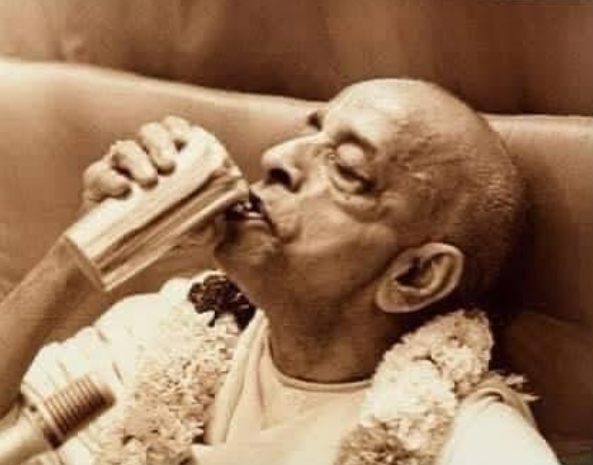
āpomayaḥ prāṇaḥ - LIFE DEPENDS ON WATER
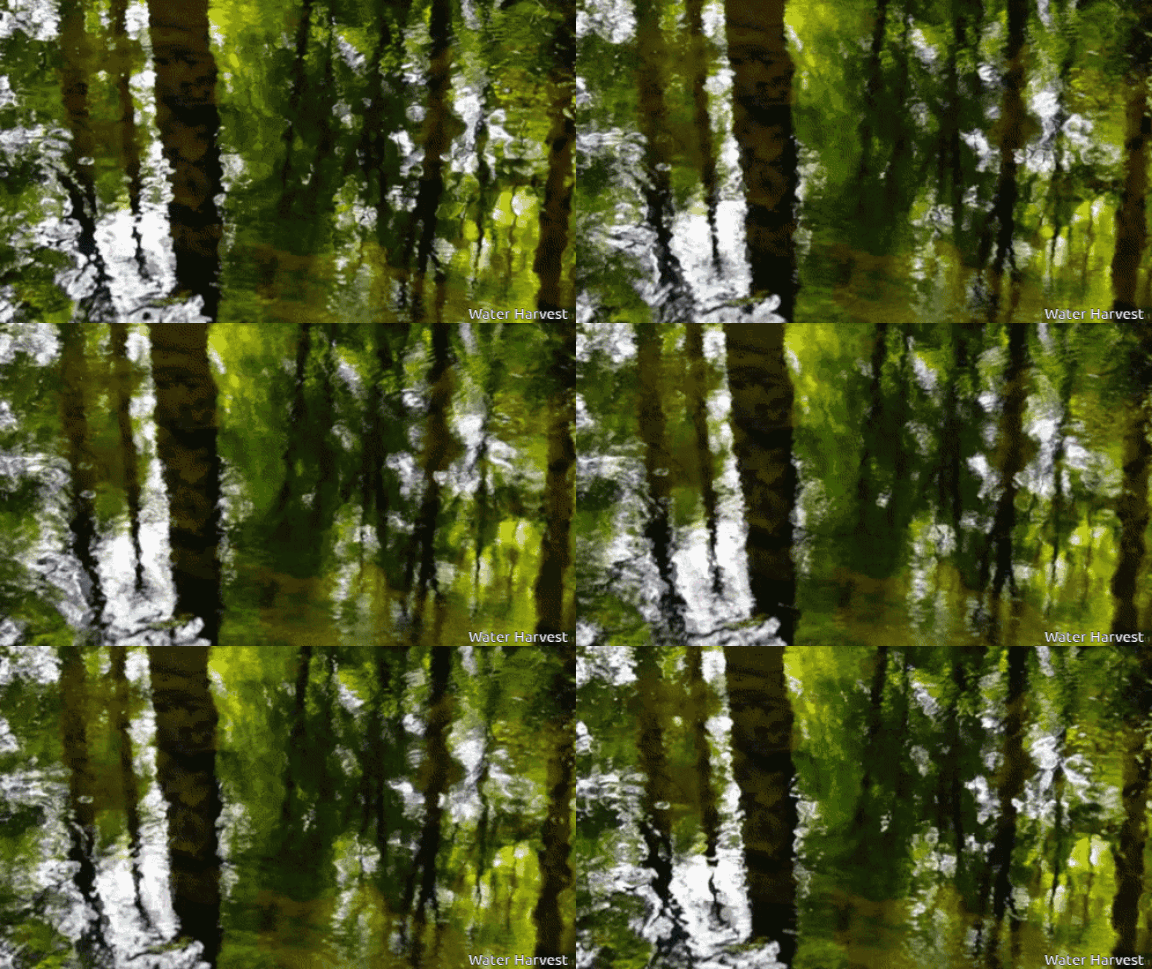
There are three types of water, surface water, groundwater and deep groundwater. The first is, rainwater; the second, water stored just below the surface in special run-off structures; and the third, deep groundwater. Six key traditional systems are used to skillfully manage all three water sources.
Traditional water sources
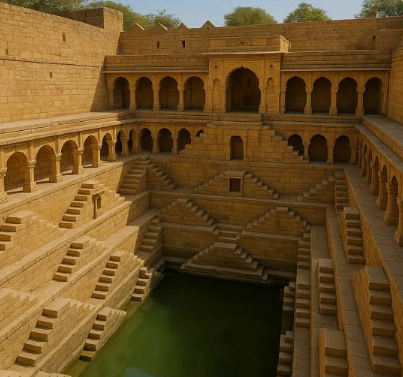
Stepwells are deep, stone-structures built to store rainwater. Ingeniously designed to reduce evaporation by limiting sunlight exposure, they provided water even in peak summers.
Ponds
Stepwells
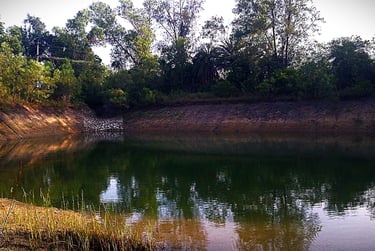
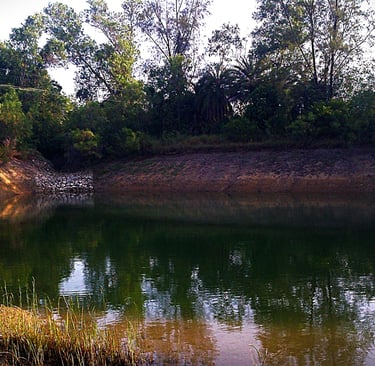
Ponds are small reservoirs. regarded as the most vital among traditional water sources. They are fed either by rain or overflow from check dams.
Check dams
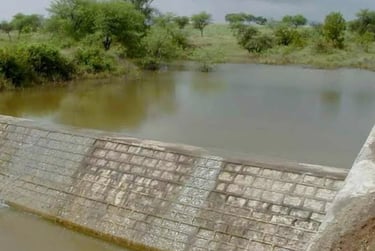
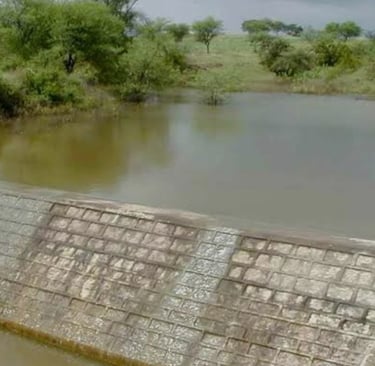
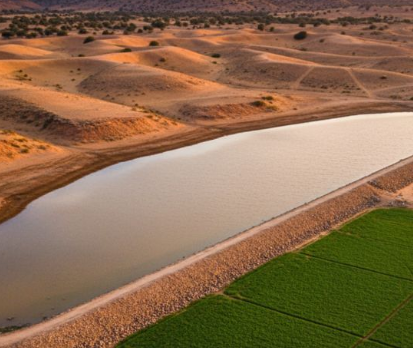
Check dams collect and retain rainwater. They are built in areas where natural embankments exist on three sides, and the fourth is constructed using dug-out soil or stone. Excess rain, is channeled to multiple connecting ponds to share the water load. They transform the area and restore the water table.
Run-off system
Run-off agricultural systems are ingenious farming systems found in arid regions. Taking advantage of gypsum-rich soil, they retain water efficiently. Similar to check dams, except, here the surrounding moisture-laden land is used for farming without the need for irrigation. The entire village shares the land and harvest, promoting community farming and sustainable use.
Tanks
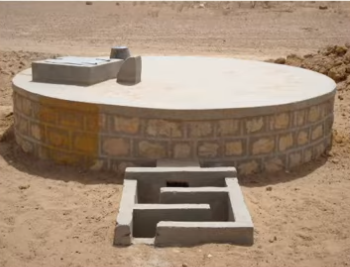
Tanks are underground cisterns used to store rainwater collected from rooftops and courtyards. Carefully sealed and filtered through layers of natural materials like leaves and stones, tankas can store anywhere from 50,000 to 500,000 liters of water. They are often found in temples, forts, and homes. One full tanka can serve a family’s drinking water needs for a year.
WATER HARVESTING SYSTEMS EXPLAINED
Wells
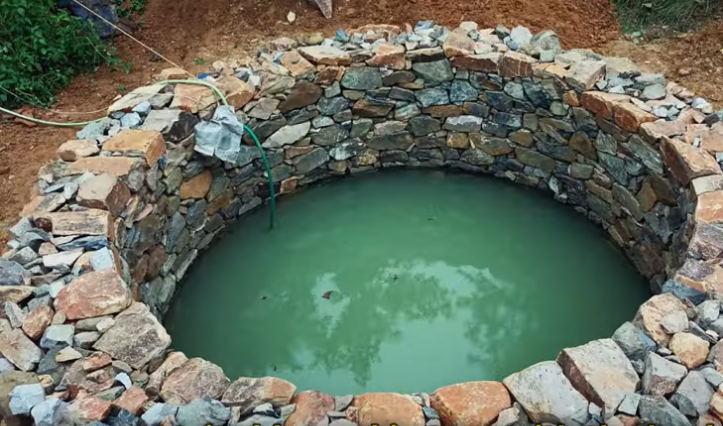
Wells are essential for daily water needs and irrigation in areas without canal systems or dams. Over reliance on wells for irregaion leeds to depletion of groundwater reserves. It is therefore necessary to construct wells within close proximity to ponds to ensure a steady percolation of fresh groundwater.

AN EXAMPLE OF A WATER MANAGEMENT SYSTEM IN ACTION
Tucked away in the Sahyadri hills in Belgaum, North Karnataka, India, you'll find Gokul Dham Eco Village. It is a 450-acre Varnashram community being developed by H.H Bhakti Rasamrita Swami.
I was fortunate enough to receive training there and be part of its earlier development. Since my time there, I see they have made steady progress. At that time, life was rough, our only water source was a small perennial stream.
The bulk of our water was carted by the bullocks by tank to the ashram, and each devotee had to fetch his own bathwater in a 20L lota on his head, and walk half a kilometer back to the bathroom.
Watch the YouTube video here to see how they are developing and managing their water.
GOKUL DHAM ECO VILLAGE
AGNIHOTRA
Prabhupāda: If you perform yajña, the water will fall down. Even if you don't perform yajña, the water is there within ground. Moisten. And if you perform yajña, you haven't got to dig water.
CONTACT US
Bali is an amazing place to immerse yourself into a rich culture, which can surprise you with its history, monuments, celebrations and, of course, food. Contact us so we can help you organize a memorable stay at one of the most magical places on the planet.